

Last winter, I was standing in a shop in a small village in western Ukraine, not buying anything. I needed to wait until there were no customers anymore to do something important – to record a song. My relative, Lyuba, works there as a shop assistant and also sings in the local church choir, and she remembers various folk songs. Finally, we were alone and I pressed the record button – Lyuba sang the song “Brynila Kosa”, which my great-grandmother used to sing. Later, it would be performed on stages in the UK, Poland, South Africa, the USA and in frontline cities of Ukraine. It is so beautiful that the further I go, the less I want to add any arrangement to it. I often sing it unaccompanied, the way Lyuba taught me.
Text: Anastasiya Voytyuk
Folk songs sink into the heart gradually, very easily, imperceptibly, but they do a great job there, leaving a solid foundation for a spiritual life. After I started learning to sing folk songs from people who truly believe in them, these songs became a real part of my life. I often find myself singing when I’m cooking or going out. It’s a sign that I’m doing well. In folk singing, I often experience something deep within me. I remember on the first day of russia’s invasion in 2022 walking down the street and humming a Cossack song, and it cheered me up.
So why are these songs so profound and live on for so long, despite not getting millions of plays on streaming platforms? The answer lies in their social context. Most Ukrainian songs cannot be sung alone and require a group to make them sound. This kind of singing is often called “polyphonic” (when each voice is quite interesting and individual), but we also have a monodic tradition in Ukraine (one-voice singing).
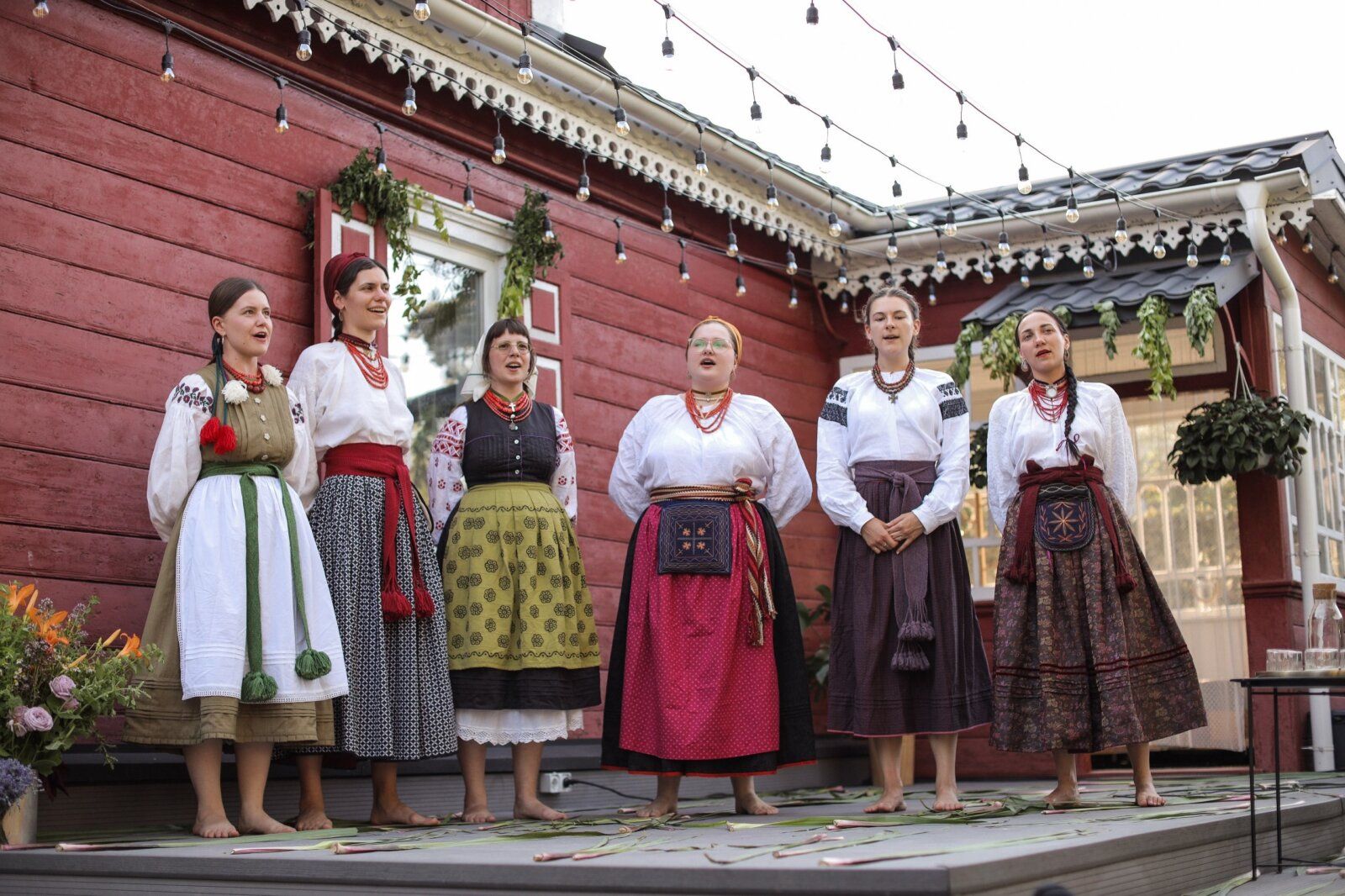
I learn traditional songs at special trainings and when I travel to villages where there are still carriers of the tradition. I would describe my experience in this kind of singing as interaction with the group, or even more – group power. It’s when you can’t sing a song alone, you can only hear its nuances and beauty when you’re singing it in a group. There are so many factors coming into play here that are important and decisive and work at the level of very deep attention, imagination and faith. You are simultaneously leading and being led, singing and listening, capturing and being captured, bathing in sound and watering your colleagues with sound waves, holding your own line and holding on to others. Polyphony is a multifunctionality that teaches us many mental processes at the same time. It is also an emotional experience and very often an emotional relief.
“The war has become a reason to develop interest in traditional music.”
Unexpectedly, the war has become a reason to develop interest in traditional music. I think it’s because we are looking for our identity – with so many thousands of Ukrainian songs from all regions of Ukraine, we have all reason to say that we are an independent nation. In total, the number of Ukrainian folk songs is estimated to be higher than 350,000, and about 11,000 of them are officially protected as a UNESCO heritage, all of them in the Ukrainian language. These songs can be divided into many genres, adult and children’s songs, for example, ritual and nonritual songs, those tied to regional holidays and those that have to do with seasonal work (such as reaping wheat or picking berries and fruits). There are also Christmas or New Year’s carols (shchedrivky), spring songs (vesnianky), wedding and funeral songs, and a separate genre, which sometimes seems to me to be the most popular, is love songs.
For example, the old song “From The Beginning Of Time’ (“Izprezhydy Vika”) tells the story of the creation of the world, and it may well be of Christian origin, as the religious character of St Peter appears in it. The song tells the story of how once there was no heaven and no earth, but only a blue sea with fires burning and saints sitting in it, who consulted and decided to send Peter to the bottom to take some sand and sow it around the world so that flowers and stars would be born. It’s a wonderful story that beautifully conveys how cosmic and romantic Ukrainians once thought about the beginnings of the world. This song comes from the Kyiv region.
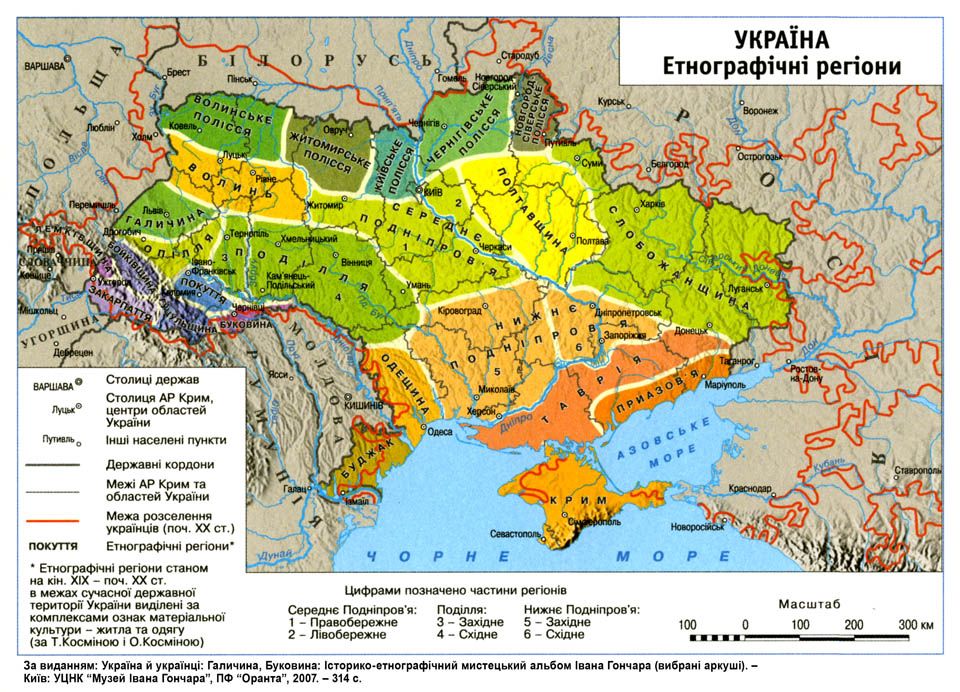
Karte der Ukraine mit ethnografischer Einteilung der Regionen des Landes
If we look at the map of Ukraine from the perspective of ethnographic division, we see that there are many regions, and of course, many variants of division, as different scholars have different theories. Some people divide them geographically, others rely on linguistic dialects. But what is most important here is that Ukrainian was spoken and sung in all these regions. There are many Ukrainian songs from the Donetsk and Luhansk regions, which are now under occupation, Podlasie (now part of Poland) and Kuban (now part of russia). Therefore, if there are many russian-speaking Ukrainians in a region of Ukraine, it does not mean that this region belongs to russia, but it means that the colonisation policy and russification there was just more brutal. Ukrainians were forbidden to speak the Ukrainian language, and Ukrainian culture was destroyed on a physical level: books were burned, speakers were killed, and the culture was banned in every way. That’s why singing is so important today as a proof and a means of reviving culture.
By the way, many young people in Ukraine are now interested in traditional singing, and this gives me great hope that our culture will live on. I really hope that we will be able to hold on and that we will preserve our country with the help of the world. In the most difficult moments, a folk song becomes a defence, encourages, gives space for hope, or takes you in its arms to cry. I really wish and believe that the Ukrainian song tradition has a great future, that it will be listened to and explored in places where it has never been heard before. That there will be many more carols like the “Carol Of The Bells”, which was inspired by an ancient Ukrainian carol and arranged by Mykola Leontovych, a researcher of Ukrainian traditional music.
I would be very happy if one day you open Youtube and look for these bands that work with traditional music and its modern arrangements in Ukraine: Bozhychi, HrayBery, Kapela Serhija Okhrimchuka, Shchuka Ryba, Yuriy Yosyfovych, Khoreya Kozatska, Yuriy Fedynsky, Kurbasy, Mariana Sadovska, Uliana Horbachevska, Natalia Polovynka, Valya Levchenko, Dakha Brakha, Lemko Bluegrass Band, Troye Zillia, Yagody, Zitkani, Ivanka Chervinska, Onuka, GO_A, G. G., Gordiy Starukh, Casa Ukraina, Mavka, Fiïnka, Kozak System, Haydamaky, Joryj Kłoc, Motanka, TaRuta, Balaklava Blues, the doox and many others.
And if you want to listen, sing or learn new Ukrainian songs, don’t hesitate to write an e-mail to me: banduragirl@gmail.com.
Further Links:
Online resources where you can hear examples of traditional singing from different regions of Ukraine:
Digital archive of folklore of Slobozhanshchyna and Poltava region: www.folklore.kh.ua
Polyphony – digital archive: www.polyphonyproject.com
Independent organisations that research and develop traditional singing:
Gurba Music Workshop: www.facebook.com/hurba.music
NGO Lilik: www.facebook.com/lylyk.traditions
Rys: www.facebook.com/rysproject
Experimental art projects:
Kovcheg: www.kovcheh.ua/en
Kolo Rayu: www.youtube.com/playlist?app=desktop&list=PLKhJx-cJnwksVM0gdvWPv148uMUT071NL
Slovo i Holos: www.slovoigolos.com
Examples of different maps of Ukraine, which represent ethnographical division: www.etnoua.info/rajonuvannja
Photo:
0 Kommentare