

Sometimes I think I’ll never be able to dream again the way I used to, because I suspect I was too bold in my aspirations. Ten years ago, I was desperate to launch a festival of contemporary bandura music, to bring together like-minded people – people who want to see the bandura in a different light, on different stages, and who are actively working towards that goal. Back then, the bandura was still very little known and associated either with academic music or with a very niche reconstruction of the folk tradition of blind wandering singers, a field dominated solely by men. But even back then, it was clear to me that the bandura is so much more – it’s an instrument on which you can play all genres of music, create your own work and reinterpret tradition.
Text: Anastasiya Voytyuk
Here I must tell you that things aren’t quite so simple with the bandura – it’s an instrument that survived nearly a century of Soviet occupation and has changed noticeably as a result. So when I talk about the bandura, I’m actually talking about a family of instruments. And when I imply that there were no festivals for the bandura, I mean there was no alternative to the festivals for the academic bandura – the sort of thing like Woodstock or a cool Celtic harp festival.
In 2017, “my” festival took place for the first time in Lviv under the name Lviv Bandur Fest, and continued right up until the start of full-scale war in 2022. Unfortunately, our festival suffered from the same fate as most Ukrainian festivals at that time: they either disappeared or were put on hold. A ray of hope for me was when a bandura player from Ukraine, Khrystyna Petrynka, who is currently studying in Germany, suggested the idea to hold a festival in Berlin. She is writing her thesis on the development of the modern bandura and once took part in a festival in Lviv.
Since 2022, a great many bandura players have left Ukraine – whether temporarily or permanently, only time will tell, but they are all cultural ambassadors for Ukraine and help to promote our culture. Incidentally, this is not the first time such a situation has arisen – previous waves of bandura players leaving their homes in search of a better life were a common occurrence during the course of the last century.
That is why the idea of reviving the festival and hosting it again in Ukraine and for the first time in Berlin both delights and daunts me, as I realise there is a great deal of work ahead, but also many joyful moments. We want to bring together musicians who were forced to leave and keep in touch with them, while at the same time showcasing the bandura in Europe.
The Berlin edition – which will be called Berlin Bandur Fest – is scheduled to take place from September 11 to 13, 2026, while the Lviv edition will be held from September 24 to 30. In addition, we will also be holding festival events in the frontline cities of Kharkiv and Zaporizhzhia. We invite you to join us and either share your own story about the bandura or simply listen and ask questions. For more information, visit our Facebook and Instagram profiles.
Aufmacher:
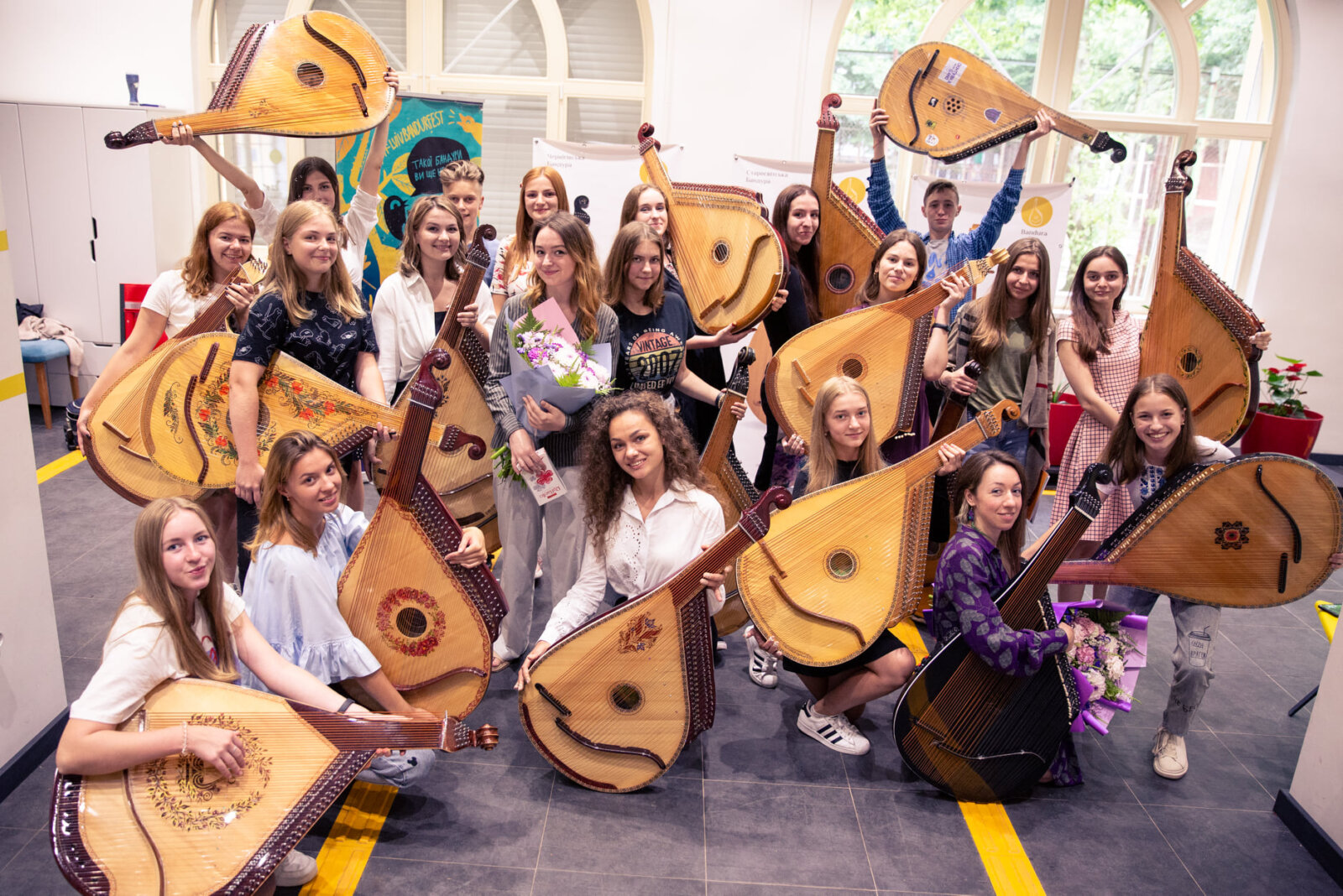
Bandura camp at the Lviv Bandur Fest – Anastasiya Voytyuk in the foreground, second from the right
Foto: Lviv Bandur Fest
0 Kommentare